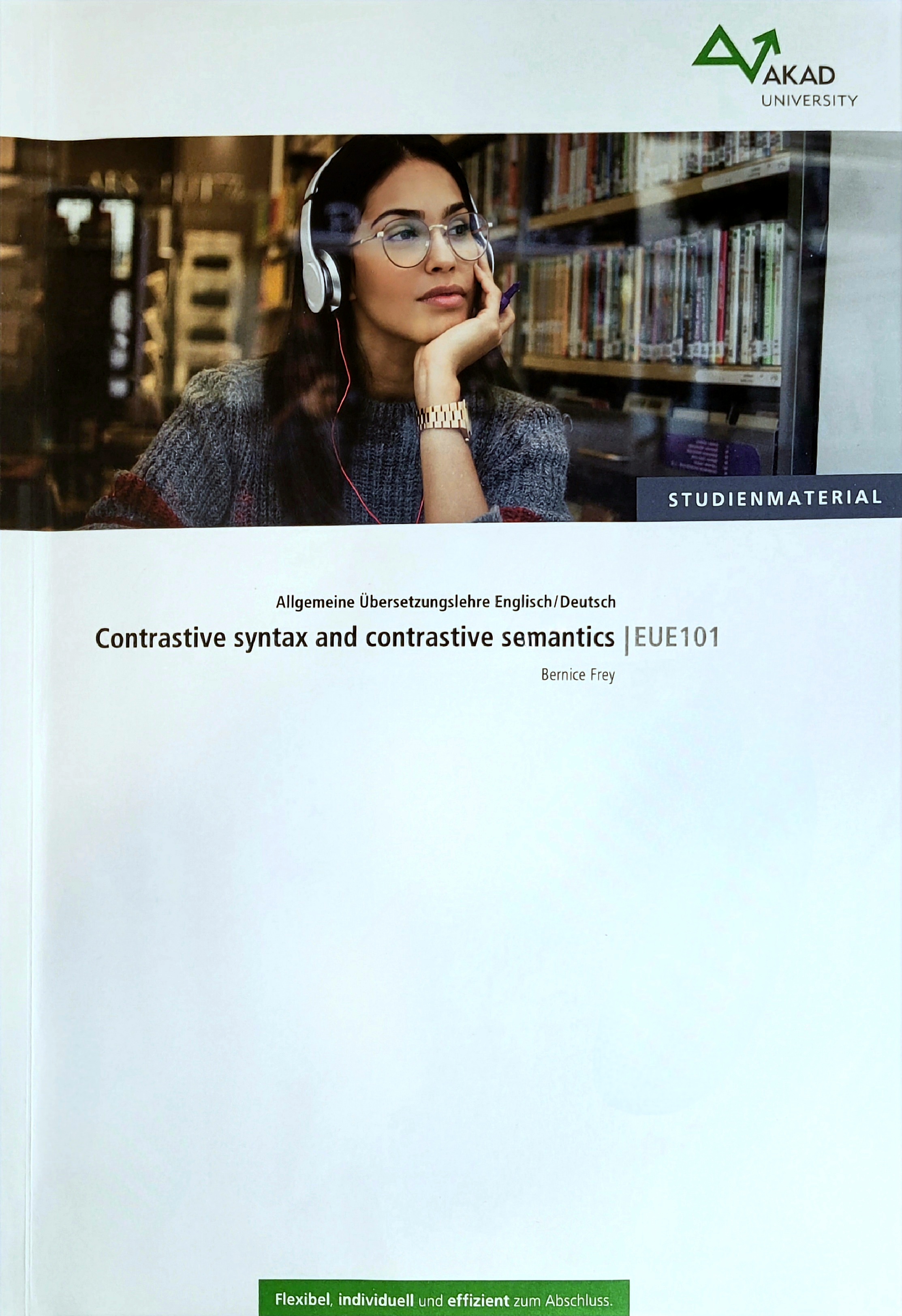
EUE101: Contrastive syntax and contrastive semantics (EUE01: Allgemeine Übersetzungslehre Englisch/Deutsch, #3)
Dear students, The words in languages are linked by various devices, a central device being grammar. Each language has its own system of grammar,...
Also Available in:
- Amazon
- Audible
- Barnes & Noble
- AbeBooks
- Kobo
More Details
Dear students,
The words in languages are linked by various devices, a central device being grammar. Each language has its own system of grammar, built over the centuries, and being determined by living conditions, history, and every other aspect of its own culture.
German and English are two languages which are closely related, and show many similarities. This is so much the case that frequently, students will respond to a perfectly “English” translation by saying, “But that sounds German”, or something similar.
Therefore, this coursebook is constructed on contrastive analysis and observation of German and English usage. The contrastive approach allows us to look at the two languages English and German and establish the similarities and/or differences that need to be considered when using these languages in translation. Interesting as this task is, it is also challenging and can even be frustrating. Moving between languages means moving between two worlds, between two mentalities, as the following extract entitled “Does your language shape how you think?” from the New York Times explains.
“Suppose I say to you in English that ‘I spent yesterday evening with a neighbor.’ You may well wonder whether my companion was male or female, but I have the right to tell you politely that it’s none of your business. But if we were speaking French or German, I wouldn’t have the privilege to equivocate in this way, because I would be obliged by the grammar of language to choose between voisin or voisine; Nachbar or Nachbarin. These languages compel me to inform you about the sex of my companion whether or not I feel it is remotely your concern. This does not mean, of course, that English speakers are unable to understand the differences between evenings spent with male or female neighbors, but it does mean that they do not have to consider the sexes of neighbors, friends, teachers and a host of other persons each time they come up in a conversation, whereas speakers of some languages are obliged to do so.
On the other hand, English does oblige you to specify certain types of information that can be left to the context in other languages. If I want to tell you in English about a dinner with my neighbor, I may not have to mention the neighbor’s sex, but I do have to tell you something about the timing of the event: I have to decide whether we dined, have been dining, are dining, will be dining and so on. Chinese, on the other hand, does not oblige its speakers to specify the exact time of the action in this way, because the same verb form can be used for past, present or future actions. Again, this does not mean that the Chinese are unable to understand the concept of time. But it does mean they are not obliged to think about timing whenever they describe an action.
When your language routinely obliges you to specify certain types of information, it forces you to be attentive to certain details in the world and to certain aspects of experience that speakers of other languages may not be required to think about all the time. And since such habits of speech are cultivated from the earliest age, it is only natural that they can settle into habits of mind that go beyond language itself, affecting your experiences, perceptions, associations, feelings, memories and orientation in the world.” Deutscher 2010, NY Times
The prime objective is thus to view the contrasts in the two languages and be able to apply the insight gained to translating. The two sections, one focusing on contrastive syntax (sentence structure) and the other on contrastive semantics (word meaning), discuss those aspects that have commonly been found to present problems when translating.
The contrastive syntax section deals with nine aspects of grammar that commonly need to be noted carefully when translating. The contrastive semantics section deals with the usage of words, and supplies you with information which will help you gain insight into the way words are used in combination in each of the two languages. Comprehensive exercises, mostly at sentence level, offer you the opportunity to apply the tools and techniques discussed, i.e. to hone your skills in translating.
Increasing your wordpower is another facet of this coursebook, although it is not part of its explicit learning objective. Use it! Every time you find a new word, or need to look up a term, you are pinpointing those vocabulary items that can bear improvement.
There is no “quick fix” for translating, let alone for translating successfully. As with any discipline, it is a matter of practice, practice, practice. That is the less good news. The better news is that, as with any discipline, if a good methodical approach is followed consistently, the results achieved can be outstanding. So get your teeth into this exciting adventure of translating – for it is truly that: a creative and interesting journey from one cultural group to another, from writer to reader....
- Format:Paperback
- Pages:102 pages
- Publication:
- Publisher:AKAD Bildungsgesellschaft mbH
- Edition:Art.-Nr. 12048
- Language:mul
- ISBN10:
- ISBN13:
- kindle Asin:B0FSJWFBLJ
About Author