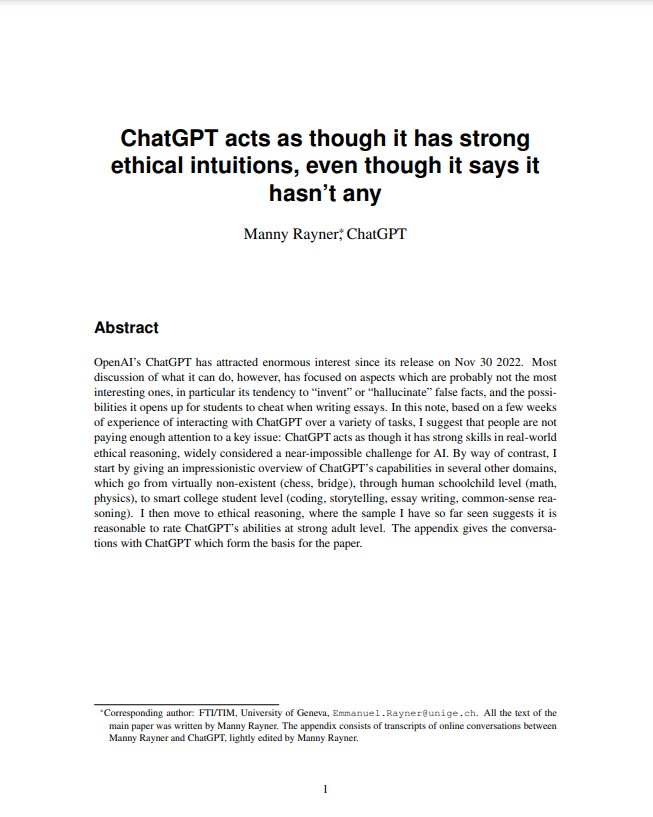
ChatGPT acts as though it has strong ethical intuitions, even though it says it hasn’t any
OpenAI’s ChatGPT has attracted enormous interest since its release on Nov 30 2022. Most discussion of what it can do, however, has focused on...
Also Available in:
- Amazon
- Audible
- Barnes & Noble
- AbeBooks
- Kobo
More Details
OpenAI’s ChatGPT has attracted enormous interest since its release on Nov 30 2022. Most discussion of what it can do, however, has focused on aspects which are probably not the most interesting ones, in particular its tendency to “invent” or “hallucinate” false facts, and the possibilities it opens up for students to cheat when writing essays. In this note, based on a few weeks of experience of interacting with ChatGPT over a variety of tasks, I suggest that people are not paying enough attention to a key issue: ChatGPT acts as though it has strong skills in real-world ethical reasoning, widely considered a near-impossible challenge for AI. By way of contrast, I start by giving an impressionistic overview of ChatGPT’s capabilities in several other domains, which go from virtually non-existent (chess, bridge), through human schoolchild level (math, physics), to smart college student level (coding, storytelling, essay writing, common-sense reasoning). I then move to ethical reasoning, where the sample I have so far seen suggests it is reasonable to rate ChatGPT’s abilities at strong adult level. The appendix gives the conversations with ChatGPT which form the basis for the paper.
- Format:ebook
- Pages:64 pages
- Publication:2023
- Publisher:Manny Rayner
- Edition:
- Language:eng
- ISBN10:
- ISBN13:
- kindle Asin:B0DM4NF6PR
About Author